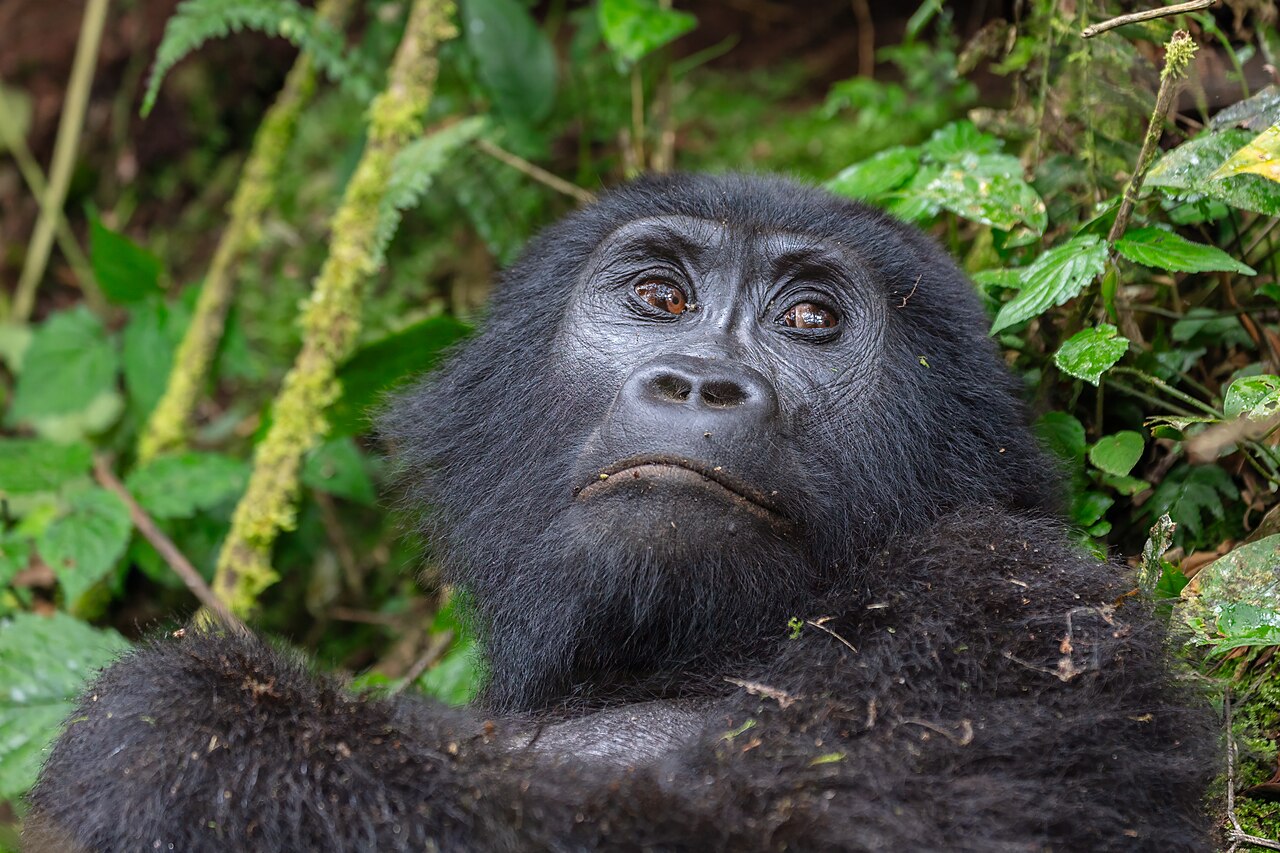
Chimpanzees are the reason most visitors come to Kibale, and Uganda Wildlife Authority (UWA) structures the visit around the Kanyanchu Primate Walk at the Kanyanchu Visitor Centre. The community there has been monitored and habituated for more than three decades, and UWA’s park page puts sighting success at over 90 percent. That track record is real, but it comes from a living forest: chimpanzees move freely, guides follow nest sites and calls rather than a marked path, and the walk’s route and effort change with each departure. UWA describes the Kanyanchu community as one of Uganda’s most closely monitored, and the forest around it also holds thirteen primate species and roughly 370 bird species. Read our Kibale National Park guide for the wider forest context.
How the trek usually runs
Treat this as a half-day commitment rather than an hour’s stroll. UWA’s park page currently schedules guided walks three times a day at 08:00, 11:00 and 14:00 from Kanyanchu, with each tracking group limited to six participants and advance booking described as mandatory. Registration and the ranger briefing happen at the visitor centre before the walk, and rangers set out expectations for behaviour and safety first. Treat the printed confirmation as the schedule that counts: published times, walk length and trail conditions are subject to change, and UWA’s visitor information warns the walk commonly runs two to five hours depending on the chimpanzees’ movements, the weather and the terrain. Once the community is found, the permitted visit is short — UWA’s tracking rules allow one hour in the chimpanzees’ presence at a minimum distance of ten metres, no flash photography, no eating, drinking or smoking on the trail, and no mimicking the calls. Reviews also warn that the forest’s biting insects reward full coverage of exposed skin.
Permits and booking
A specific chimpanzee-tracking permit is required, and it is bought separately from park entry. Foreign non-resident and rest-of-Africa visitors cannot buy permits directly: UWA books them only through tour operators licensed by the Uganda Tourism Board, states that it has no agents anywhere in the world, and requires payment in full at booking since its 2026 tariff circular removed the older reservation window. Fees sit on UWA’s published tariff card; we deliberately do not reprint a rate here, following our park guide’s policy, because UWA’s own documents have differed and a revised 2027 tariff has already been announced — confirm the current figure for your category, what it includes, and any low-season condition directly with UWA or your operator when you book. One published detail genuinely diverges: UWA’s tracking rules list a minimum age of 12 years while its Kibale park page currently states all visitors must be at least 16. Assume the stricter figure for anyone between the two until your operator confirms in writing.
Who it suits
The walk suits travelers who value a real forest experience — mud, uneven footing, a variable pace and an encounter that runs on the chimpanzees’ terms, not a schedule’s. It pairs naturally with gorilla trekking in an Uganda route: our Bwindi Impenetrable Forest gorilla trekking guide covers the other flagship permit call. It is less suitable for a rushed stopover, for anyone expecting a vehicle-based safari, or for very young visitors given the age guidance above; discuss mobility or health questions with UWA when booking. Visitors with extra time in the forest can also read our Kibale chimpanzee habituation experience guide — a full day with a semi-habituated group run by UWA.
Staying near the trailhead
A forest-edge stay near Kanyanchu makes registration comfortable on an early walk; Fort Portal works as a staging town if townlife is part of the trip, at the cost of a longer drive on trekking morning. Compare bases on the drive to the visitor centre as well as on amenities. For one base near the departure area, see our Kibale Forest Camp guide. The road approach from Kampala and a calmer two-night outline are covered in our Kibale chimpanzee-trek planning guide.
Track with care
The chimpanzees set the pace; your ranger sets the distance. Stay where you are placed, keep voices low, follow the ranger’s instructions throughout, and do not enter the forest when ill — UWA’s rules state chimpanzees can catch human diseases. The same rules bury human waste 30 centimetres deep and forbid littering. Confirm the current briefing rules with your ranger, as primate-visit guidance is periodically updated.